Welcome to the Sweet Lab
The Sweet laboratory investigates regulation and impairment of insulin secretion in type 2 diabetes; pancreatic beta cell death; metabolic basis of inflammation and T cell calcium metabolism in type 1 diabetes.

Fundamental mechanisms regulating insulin secretion by the pancreas
A primary determinant of developing diabetes is the ability of specific cells in the pancreas to secrete insulin. When these cells (called beta cells) do not respond to rises in blood glucose by secreting the appropriate amount of insulin, blood sugar levels can remain high commonly requiring treatment with injected insulin or oral medications. In order to understand why the function of beta cells becomes impaired, our laboratory studies the biochemical mechanisms that mediate the sensing of glucose levels by beta cells and the intracellular signaling that tells the beta cells how much insulin to secrete. One such signal that is calcium, a cation that enters the cells upon glucose stimulation, and is essential for the release of insulin. However, how calcium interacts with intracellular proteins to promote the release of insulin is not understood, making it difficult to know what is going wrong during the development of diabetes, and how to correct it pharmacologically. Our laboratory has recently discovered unique features of an additional signaling molecule, called cytochrome c. This protein has long been established to be involved with the generation of energy needed for maintenance of cell function, however we have found that changes in its configuration and movement from one part of the cell to another, may operate in conjunction with calcium to regulate the appropriate amount of insulin release. Importantly we have recently found that a lack of signaling by cytochrome c can result in decreased insulin secretion, demonstrating the proof of principle that impairment of this signal could be a cause of diabetes. Present work is focused on factors that control the configuration of cytochrome c and how this could be contributing to the risk of diabetes.

Microphysiological Systems
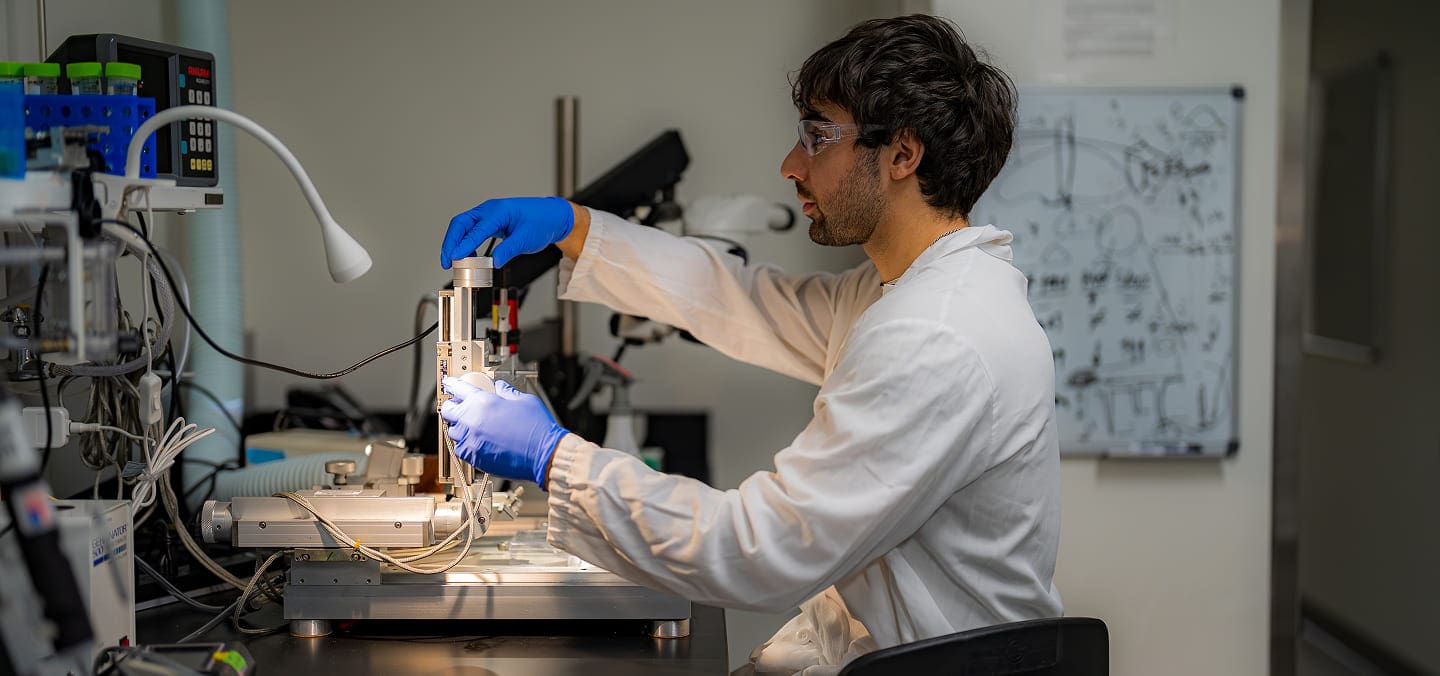
It has been widely recognized that maintaining primary tissue and cell models in general, under fluid flow while positioning cells such that 3D cell-to-cell contact is preserved similarly to in vivo, is critical to obtaining reliable data that better reflects in vivo behavior. Thus, NIH and many companies are working hard to develop organ-on-a-chip and other approaches to studying cell biology using in vitro methods. Our laboratory continues to devote effort designing and engineering fluidics systems for maintenance and assessment of cell and tissue response to compounds and physiological and pathological conditions. Specific and custom applications of the instrumentation include the study of islet, retinal and liver physiology, and optically based measurements of metabolic and regulatory signals including oxygen consumption, mitochondrial redox state, calcium and other ion fluxes. The concomitant measures of cell function, such as insulin secretion or glucose production, and regulatory signals, provides an effective platform for studying cell physiology. Current efforts are directed at innovative ways of increasing the throughput and duration of the experiments of the systems so that
Drug toxicity testing. Although the major goal of pharmaceuticals are to treat of prevent symptoms, very often it is the side effects that determine whether a drug will ultimately be suitable for widespread use. Since both pharmaceutical companies and patients’ desire getting drugs to market, there is an exigent need to improve and speed up drug toxicity testing methodologies. Our laboratory is using ultra-sensitive methods to resolve small changes in mitochondrial function in response to low levels of drugs, far below the levels that can be tested with standard methods. We predict that the approach will make the drug testing process more efficient and improve the probability of drugs making it to market with less toxic side effects. We are working closely with Astra-Zeneca, Novo Nordisk and Cell Systems to ensure that methods being developed address the needs of the drug development community and can more effectively contribute to bringing effective and safe diabetes drugs to market.
How Can This Research Help People With Diabetes?
Drugs to increase insulin sensitivity, insulin secretion, and lessen damage of diabetes to tissues are needed to better combat the symptoms and complications of both Type 1 and Type 2 diabetes. Our methods generate detailed real time responses of compounds and conditions on readouts of tissue function and viability. Strategically designed experiments using our systems facilitate the study of the mechanisms mediating function and dysfunction of tissues playing a role in control of blood sugar and diabetic complications. By applying these methods to both animal and human tissue, in conjunction with drug development work carried out by pharmaceutical companies, efficacy and toxicity of drugs designed to normalize these processes are subsequently tested and optimized.
At a fundamental level, we use real time experiments to understand mechanisms mediating insulin secretion, compensatory adaptations in response to increased insulin resistance, and the waning secretory function that occurs during the development of diabetes. We have focused on novel signals being activated in, and transported out of, the mitochondria, an organelle that generates energy as well as a multitude of regulatory signals. The resulting elucidation of novel mechanisms can increase our understanding of factors governing the development of diabetes, point to targets for therapeutic intervention aimed at normalizing blood sugar in diabetics. In addition, understanding of new regulatory mechanisms provides the basis for assays to assess efficacy and dose-dependency of drugs to increase function and reduce diabetic complications. In this way, basic research critically guides efforts to develop new medicines to prevent and ameliorate the causes and symptoms of diabetes.